A Quick Guide to Translating Your WordPress Website into Any Language
Providing multilingual content is an increasingly important requirement for sites worldwide.
In this article, we’ll show you why translation is so important, how to prepare your material and source translators, and how to manage multilingual content in WordPress.
Let’s start with whether you should consider translation at all.
Why You Should Translate Your Website
It can be hard to appreciate if you’re living in the Anglosphere, but English is a long way from the only game in town online.
Though English has dominated the web to date, nearly 66% of internet users are non-native English speakers and over 50% of all Google searches are in languages other than English. Those numbers are only going in one direction as well. As the rest of the world comes online, English is set to remain the lingua franca, but things are about to get a lot more polyglot pretty quickly.
This trend has been on the radar of the WordPress community in the last couple of years, with translation an increasingly hot topic and plugin translation now on most developers’ minds. The WordPress core team has also been mulling over the issue in recent times.
No matter how you slice it, there is a huge addressable market out there for sites of all shapes and sizes that monolingual sites (whether English or otherwise) just don’t cater to.
Translating content is a potential issue that sites of any kind of real scale will have to at least consider sooner or later. Depending on your geographic location and audience, it’s a need you might have to address tout suite even if you’re just starting out.
Let’s step through the main pros and cons starting with the potentially easy wins that translation can bring:
- An increase in search traffic. Site owners such as Neil Patel have managed to increase search traffic by 47% in only three weeks by leaning on machine translation to quickly translate content into 82 languages.
- Better ranking on international search engines. Google dominates in English, but it’s a long way from top spot in a very small but increasingly important set of markets. Russia, China, and Japan are the three big territories that stand out here.
- The ability to enter multinational markets. Single-language sites are at a major disadvantage in a global marketplace. Non-English sites should offer English as a courtesy to international viewers, while English-speaking sites should at least focus on their nearest target language. This could be Spanish in the case of American sites or German in the case of British or European sites.
Translation is not the sort of project you just merrily stroll into as a site owner, however. There are also some potentially hairy downsides to consider before you take the plunge. Chief among them is the following:
- Translation management. Managing a translation project brings its own set of concerns, the main one being do you actually have anybody on staff who can speak the target languages? If not, you will be forced to put yourself entirely in the hands of the translators when it comes to quality control.
- Cost. Good translations cost money and the potential for embarrassment if you cut corners is large. Do you have adequate budget in place to really tackle translations professionally? If there is a back office or support component to servicing site users in another language, can you really handle it?
- Site Performance. You want to be very certain that introducing a second or third language to your existing setup in WordPress doesn’t suddenly tank site performance or introduce unnecessary complications in terms of the overall user experience.
As with most things in life, common sense and judicious application of Occam’s Razor should be your guiding stars. If you’re running a website for a small hairdresser in suburban Pittsburgh, translation should not be at the top of your to-do list. If, on the other hand, you’re managing a boutique hotel in Berlin but only provide site content in German, you’ll be looking to get the translation ball rolling in a hurry to maximize your reach.
We’ll assume you’ve got a pressing need for translating your site for the remainder of the article. Let’s crack on with things and look at the first step you need to take – getting ready to actually transform content into another language.

Preparing Your Content for Translation
Once you’ve decided to bite the translation bullet, it’s time to start getting specific in terms what actually needs to move from language A to language B. Here are the key initial points to address in terms of whipping your content into translatable shape:
- Perform an existing content review: You need a clear overview of the size of the task at hand before you do anything else. Perform a complete content review of your existing site and clearly list what will and won’t be translated. Translation is typically charged per word, so handwavey “estimates” about how much content you have won’t cut it. You need a nailed-down list and a fixed word count.
- Decide on the type of translation: This basically boils down to a choice between human and machine-assisted translation. Human translation is always preferable, but budget can be a factor here. Get familiar with standard translation rates per language and use them as a guide to whether you can actually afford professional human translation. If you’re going down the machine route, you’ll have to live with the fact that translations will be passable at best.
- Identify who’s in charge: As alluded to above, translation projects are inherently tricky by nature. Make sure the project has one clearly defined owner (ideally a native speaker of the target language) and carefully considered milestones. Managing a full translation project can be a minefield so you want someone with organizational chops who’s not afraid to crack the whip in terms of deadlines and quality control.
- Factor in search engine optimization: Multilingual SEO isa broad and occasionally baffling topic and we won’t attempt to cover it in its entirety here. It needs to be on your radar, though.Search Engine Land, WPML and Moz.com all have excellent resources to dig deeper into the topic. If you’re looking at porting an existing site with a large amount of high-ranking content, it’s going to be worth your while talking to an expert in multilingual SEO directly.
- Identify your WordPress solution for publishing: There are a number of different approaches you can take within WordPress for actually delivering multilingual content. We’ll step through the main options here shortly, but it’s a subject you want to consider as close to the outset of the project as possible to ensure things run smoothly.
Once you’ve got your ducks in a row in terms of overall preparation, it’s time to actually engage the services of a translator.
Picking the Right Translator
As mentioned above, there are two basic options for translating your content: either get a human to do it or trust your luck to a machine. Let’s get the latter option out of the way first.

Machine translation has admittedly come an enormously long way in the last ten years – witness the increasingly impressive efforts of Google Translate for example – but it’s still a substantially less desirable option than professional human translation.
We recognize, of course, that some site owners may be really up against it in terms of time, budget and overall available resources, so occasionally machine translation may well be your only realistic option. In that case, by all means go for it, but be aware that it will inevitably be a long way short of perfect. Human translators will always be more accurate.
When you’re choosing a human translator, you have three basic options:
- In-house resources: For obvious reasons, the ideal solution is someone on your team who is fluent in the target language and already understands your business. If this is at all possible, go for it.
- Freelance translators: These are widely available on sites like Upwork and Fiverr if you are willing to invest the time in quality-checking and managing candidates. Specialist translation sites like Proz are also worth checking for freelance translators. The local embassy for your target language should also be able to provide you with a list of recognized translators, though prices here are likely to be at the top end of the range.
- Agencies: Again, you have a basic choice of online or offline resources here. A quick Google search or chat with someone in the relevant embassy should get you a list of offline/local resources. Online agencies such as One Hour Translation, TextMaster and Tolingo are also worth a look. Make sure you’re following a sensible set of guidelines when assessing agencies.
As with most types of projects, if you’re dealing with a supplier for the first time, it’s well worth asking them to complete a small test translation before going all-in on handing over what could potentially be a large amount of content that you’ll be paying a significant amount of money to get translated.

FREE EBOOK
Your step-by-step roadmap to a profitable web dev business. From landing more clients to scaling like crazy.

FREE EBOOK
Plan, build, and launch your next WP site without a hitch. Our checklist makes the process easy and repeatable.
Regardless of which option you go for above, one factor you will have to consider if you do not understand the target language yourself is the subject of quality control upon delivery.
If your budget can handle it, it’s highly recommended that you have a native speaker perform quality assurance on the project deliverables. Translation is an inherently nuanced craft and it’s all too easy to get something that looks roughly right to someone with basic knowledge of the language, but that sounds dreadful to native-speaking ears.
Right! With all that out of the way, let’s move on to actually presenting your multilingual content to the world in WordPress.
Managing Your Translated Content in WordPress
There are two basic methods you can employ in WordPress to wrangle your translated content into shape. The most popular approach is to make use of a multilingual plugin to handle the heavy lifting of arranging translated content behind the scenes.
We’ve identified three options here in that regard, with the final one being something of a last resort. You’ll find options for engaging professional translation providers with both of the first two options.
1. Polylang
First up we have Polylang – a relatively recent addition to the multilingual space in WordPress, but already boasting over 100,000 active installs and very high average ratings.
As befits a multilingual plugin, Polylang’s admin interface is already available in 41 languages. Solid online documentation is also at hand detailing all common aspects of its use.
Polylang includes support for right-to-left (RTL) languages and can be used to handle translations of pretty much any common aspect of your WordPress site such as posts, pages, media, categories, tags, and menus.
You can include a customizable language switcher as either a widget or integrate it within your navigation menu. Professional translations can be sourced from within the tool thanks to an integration with Lingotek Translation.
2. WPML
The WPML plugin from OnTheGoSystems is very much the grand old man of WordPress multilingual solutions and has been on the scene since 2007.
WPML is a premium plugin, with pricing ranging from $29 to $195 depending on which license you go for. As you’d expect from a plugin that’s been in active development for over seven years, it’s a feature-packed affair and comes with a range of add-on plugins you can use to really leverage its power.
WPML stands out both for the range of themes and plugins (premium and otherwise) that it’s proven to work smoothly with, and for the quality of its online documentation and support.
WPML also supports management of translation projects from within the plugin and have a partnership with translation provider ICanLocalize if you are looking to outsource translations.
If your budget supports shelling out for a premium option, purchasing a copy of WPML puts you in safe hands with a tried and tested solution that’s the market leader for good reason.
3. Google Language Translator
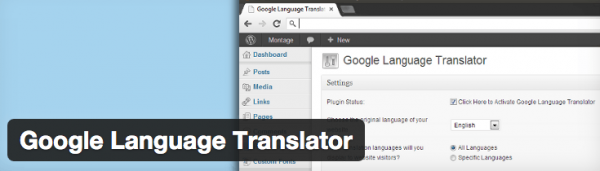
Google Language Translator is a free plugin that enables you to hook into Google Translate to provide automatic machine translations of your content.
As we stressed already in this article, this is really a last resort option, but it might be enough to get some site owners over the initial hump in terms of testing desire for multilingual content on the part of their audiences.
You’ve got options for showing and hiding Google branding and specific languages, along with support for shortcodes in posts, pages and widgets.

The Multisite Approach
The second main method of handling your translated content in WordPress is leaning on native Multisite functionality in order to have each language in its own WordPress install. You can find basic instructions for going down this route outlined in the WordPress Multilingual Codex.
If you’re considering this approach, both the Multisite Language Switcher plugin and MultilingualPress are worth investigating to make things a little easier to manage.
On balance though, you’re probably better off going with a tried and tested solution such as WPML or Polylang to handle things.
Conclusion
Tackling a translation project represents a substantial investment of both time and money, but the results for your business can be stellar.
To get the most bang for your buck, make sure you really invest the time at the planning stage to cover the main action items we’ve highlighted – in particular the areas of existing content review and assigning a clear project owner.
The success of your project will ultimately stand or fall on the quality of the translators you employ, so be prepared to do some serious due diligence here and use the tips we’ve outlined to guide you.
Luckily, once the translations are actually sourced, getting them into WordPress is relatively straightforward using the plugins we’ve mentioned.
Tags:
Aileen Javier Aileen has over 10 years of experience in content writing and content marketing. She’s handled content teams, planned editorial calendars, and managed projects. She’s also written blogs, web copy, social media posts, and email newsletters for brands in different industries.